Broadly, printing consists of reproducing images or text onto another material such as paper, plastic, or fabric. This can range from a single print to a mass production, and almost every single process involves pressing one material against another.
In this blog, we will get into the basics of printing, as well as learn a little more about the most common printing processes.
Printing Basics
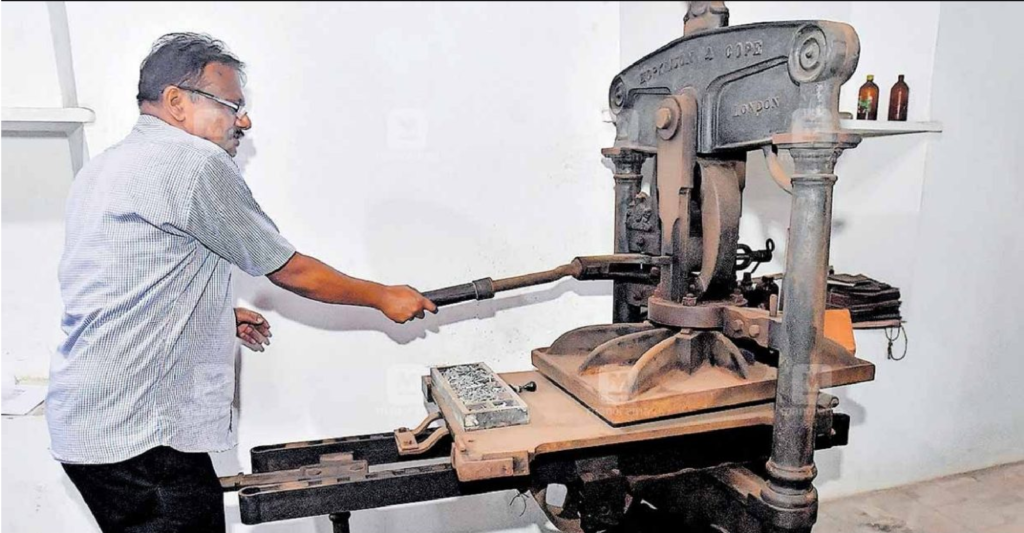
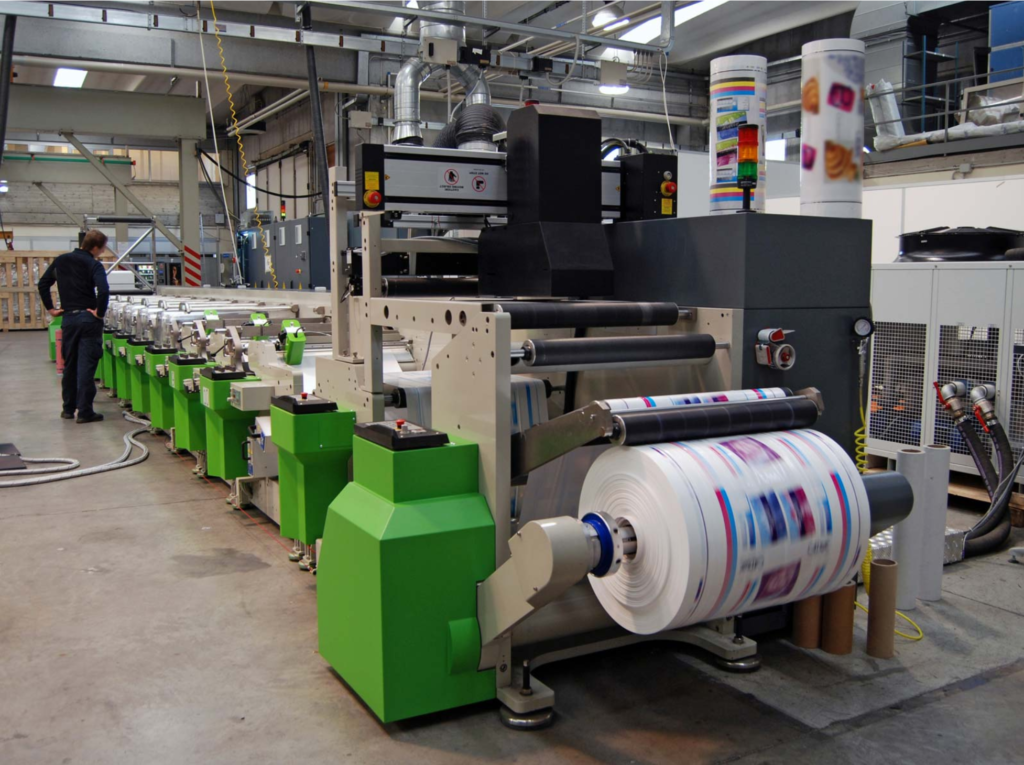
Typically, printing involves converting text or artwork to a printable form, called a printing plate, which is then coated in ink and pressed against whatever material you’re working with to create a print.
The simplest type of printing press involves a table with an overhead screw and lever mechanism that forces the inked plate against the material. Hand operated machines like this are still used to produce small volumes of printed materials, but the printing industry has been broadly overtaken by the modern press, which utilizes cylinder mechanisms rotating at high speeds which produce thousands of copies an hour.
Other popular forms of current printing include photocopying, inkjet, and laser printing, which work using heat or static electricity. However, we’ll be focusing on mass production techniques that utilize modern color presses.
The Modern Printing Press
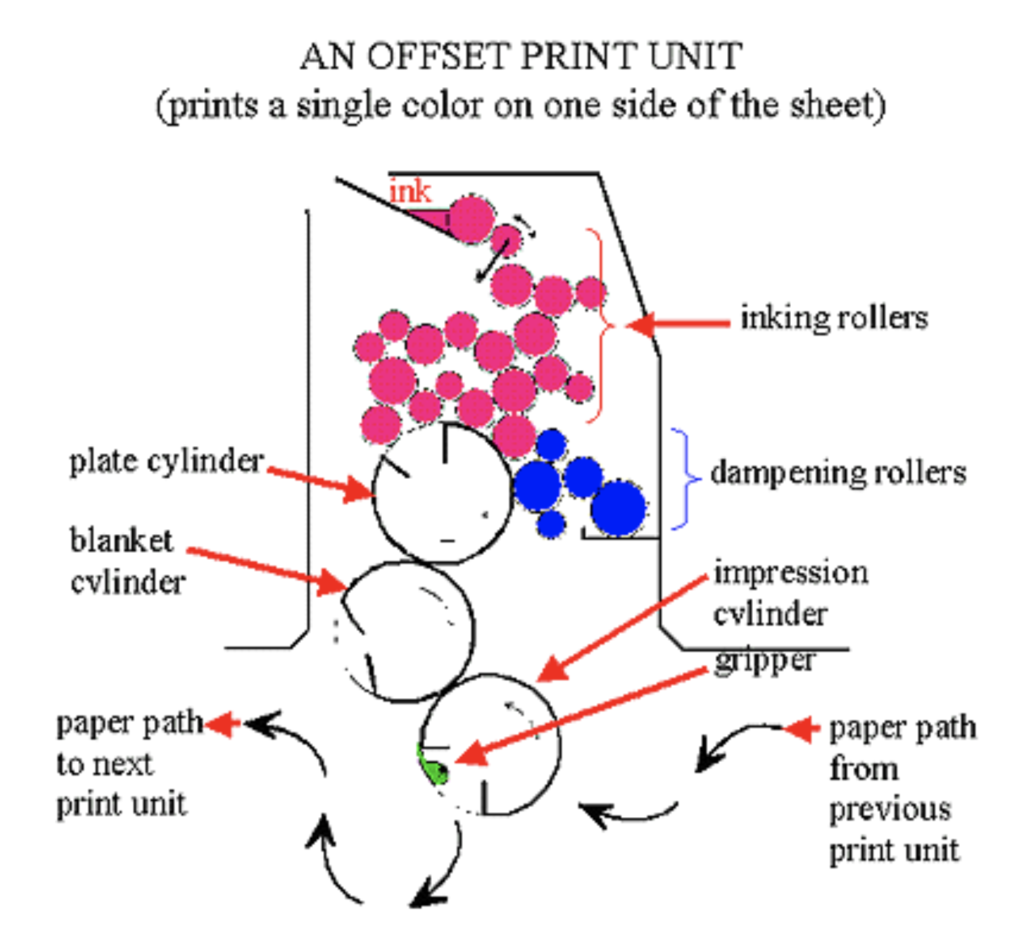
Graphic via Society for Imaging Science & Technology
The most common printing press in production today is the offset lithography press. These machines are commonly fed in sheets of material which are pushed through rotating cylinder mechanisms in which ink is added.
There are separate printing units, or towers, for each color of ink, which are often just C (cyan), M (magenta), Y (yellow), and K (key/black). However, there can be up to 12 towers on one printer, first printing 6 colors one side of the material, flipping it over in a device called a perfector, and printing 6 colors on the other side.
Each printing tower has 3 main cylinders: the plate cylinder, the blanket cylinder, and the impression cylinder. The three cylinders rotate at the same velocity so that they contact each other without sliding. The graphic above shows how the ink image is formed on the plate, transferred to the blanket, then transferred to the material (held on the surface of the impression cylinder).
Printing Processes
Offset Lithography
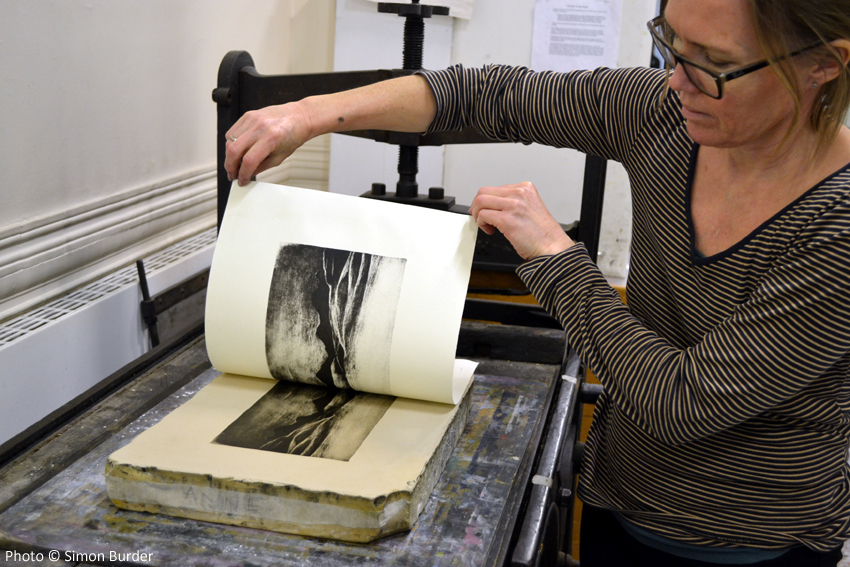
Photo via Simon Burder, Putney School of Art & Design
Lithography was invented over 200 years ago by Alois Senefelder, a German actor that wanted to print his own manuscripts. He realized that he could draw and write on limestone and transfer that work to paper. This process became more and more popular over time, and has evolved into the method it is currently.
Today, offset lithography is a very common form of mass-production printing. The process uses aluminum plates that hold the image of the print which are then put onto rollers or rubber blankets which transfer the image to the print media.
The flexible material used in the rollers and rubber blankets means lithography works well with any and all paper and media types, including rough surfaces such as wood, canvas, and cloth.
Offset lithography’s cost and simplicity makes it a feasible and effective method of printing for both high and small volume print jobs.
Letterpress

Photo via New Mexico Magazine
Letterpress printing creates a blind image using raised metal plates to push the image into the paper. The image is either inked before the process, after the process, or not at all depending on the taste of the user.
Letterpress printing is a form of relief printing that consists of carving away a surface and printing on the raised remains (or vice versa). Letterpress prints are mostly recognized for being high-end, exclusive, and refined.
Flexography
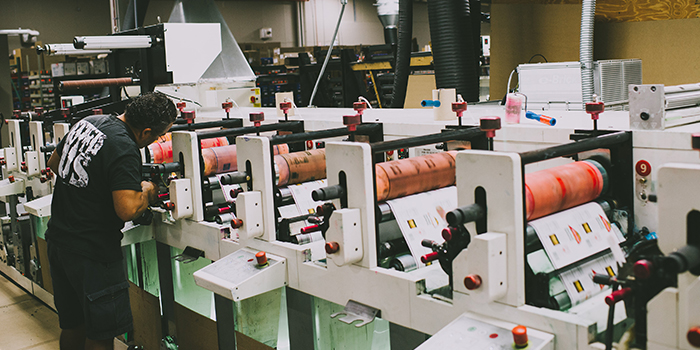
Flexography is a modern, high-speed process suitable for most packaging and labeling. It is fast, cost-efficient, and provides a high-quality label that is suitable for most mass-produced goods.
The starting material comes in the form of a roll, which then passes through a series of rotary flexible relief plates. A specialized roller feeds each flexible plate with ink, with a single flexible plate required for each individual printed color. The relief plates work in tandem to provide all colors for the final print product. This method allows printing on many different materials, including:
- Plastic
- Cardboard
- Fabric
- Metal
- Film deposits
Due to its flexibility, flexography is used to print things such as self-adhesive labels, food packaging, and plastic bags. Flexographic label machines have made this method more efficient than other label printing methods without sacrificing any quality.
Gravure

Gravure printing is similar to flexography in the way that it is a long run, high speed, high quality method. This process works well with CMYK printing where each color is applied by its own cylinder with drying inbetween.
This printing process, much like flexography, is used to produce things such as packaging, wallpaper, and gift wrap. However, in smaller use cases, gravure printing can be used to print magazines, greeting cards, and large-scale advertising.
Screen
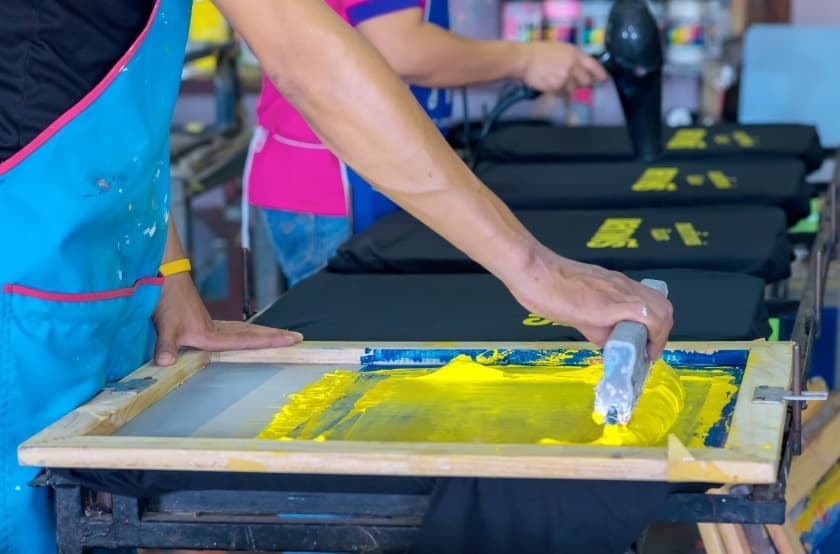
The dictionary definition of screen printing is “the technique of creating a picture or pattern by forcing ink or metal onto a surface through a screen of fine material.”
The Japanese used to cut stencils out of paper, created mesh screens using hair, and pushed ink through using brushes. This was one of the first reasonable means of screen printing. Since then, screen printing has evolved into the press we use today.
Screen printing can be used to apply ink to any flat surface, but is most commonly used for fabric, paper, wood, glass, and metal.
While the end result is often very similar, there are clearly many different printing processes to choose from with some more suitable for certain productions and some more suitable for other productions. It’s important to know what methods of printing work for what products so that we can prepare the design for that method as well as make sure that the print is done in the fastest and most cost-efficient way possible.
It can be intimidating to choose the right printing process for your project, but I hope this blog has given at least the slightest bit of insight to your search. When all else fails, talk to your local print shop representative! They know better than anyone, and will point you in the right direction. Printing should be exciting, not scary!
References
https://www.ncbi.nlm.nih.gov/books/NBK424340/
https://www.bbpress.co.uk/news/what-are-the-different-printing-methods-available
https://www.starlabel.com/blog/flexography/
https://www.lifewire.com/what-is-gravure-printing-1074611
https://www.screenprinting.com/blogs/news/what-is-screen-printing